
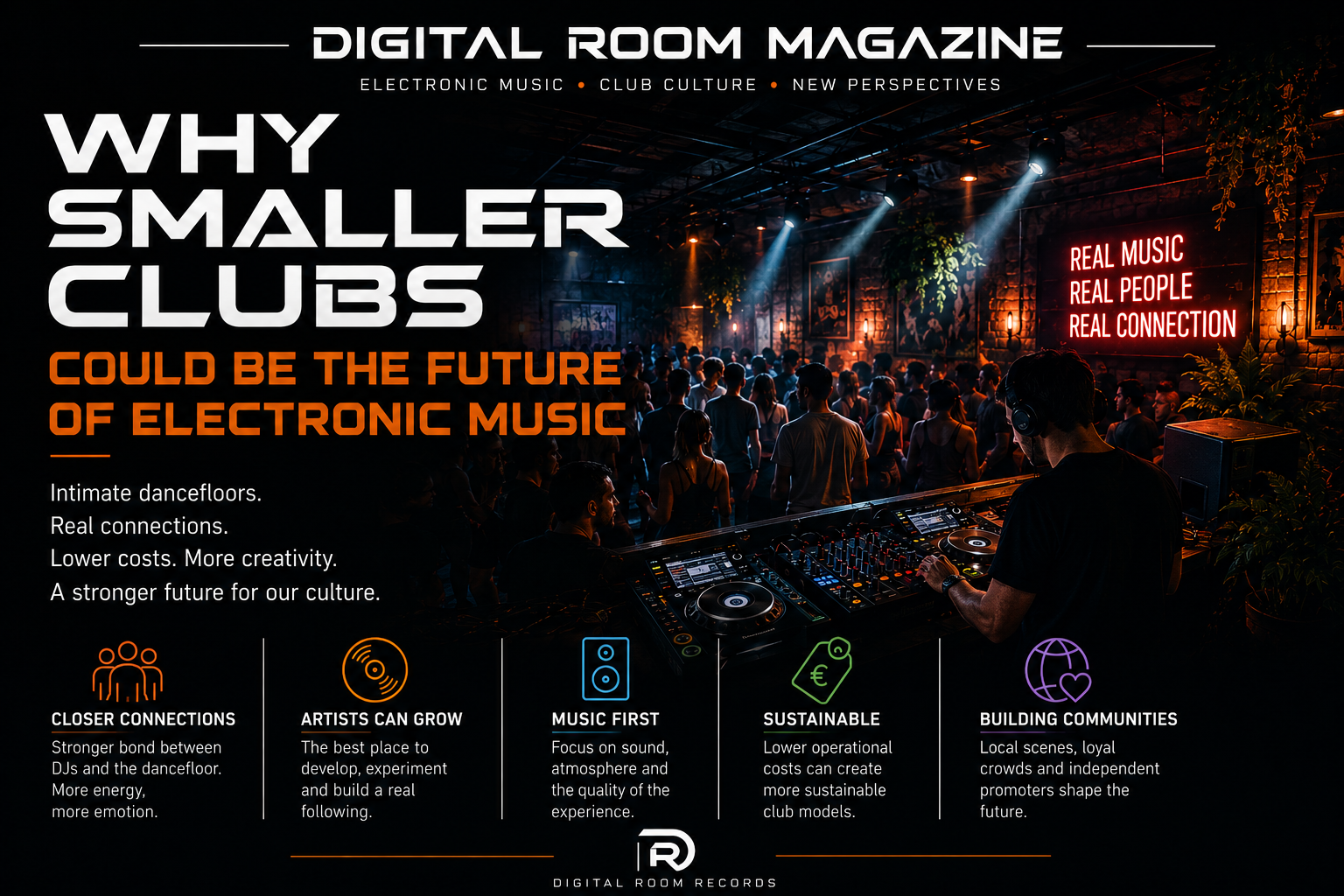
Electronic music has always been about connection.
A DJ, a sound system, a dancefloor and a crowd can create something that is difficult to reproduce anywhere else. Yet over the last decades, club culture has increasingly moved toward bigger venues, larger productions and ever more spectacular experiences.
But perhaps the future of electronic music does not necessarily belong to the biggest clubs.
Perhaps it belongs to the smaller ones.
Bigger Doesn't Always Mean Better
There is nothing wrong with a spectacular superclub experience. Massive sound systems, impressive lighting and international DJs can create unforgettable nights.
But scale comes with a price.
Large productions require more staff, higher operating costs, bigger artist fees and increasingly sophisticated technology. Those costs ultimately have to be covered by the audience.
Smaller venues can operate differently.
A club with a few hundred people can concentrate on what really matters: the music, the atmosphere and the people on the dancefloor.
Where Artists Can Grow
Smaller clubs have traditionally played an important role in developing DJs and producers.
Before an artist plays a major festival or a legendary club, there is usually a long period of playing smaller rooms, local parties and independent events.
These environments allow artists to experiment.
They can test new music, develop their style and learn how to read a crowd without the pressure associated with a massive production.
For emerging artists, that opportunity can be invaluable.
The Dancefloor Feels Different
There is also something special about intimacy.
When a DJ is playing to a few hundred people, the relationship between the booth and the audience can feel much more direct.
You can see people's reactions.
The crowd can influence the direction of the set.
The DJ can take risks.
And sometimes a small room full of people who genuinely love the music can create more energy than a huge venue filled with people who are simply attending the biggest event of the night.
A New Opportunity for Independent Promoters
Smaller venues can also create opportunities for independent promoters.
Instead of competing with major entertainment companies for the biggest artists, independent promoters can build their own identities around particular sounds, communities and local scenes.
A night doesn't necessarily need a superstar DJ to be successful.
It needs a reason for people to come back.
That could be a particular genre, a label, a resident DJ, a unique venue or simply a community that feels like home.
The Future Could Be More Diverse
The future of electronic music does not have to be a choice between superclubs and small underground venues.
Both can exist.
The major clubs can continue to deliver spectacular experiences while smaller venues provide the space where new ideas, artists and scenes develop.
In fact, the two sides can benefit each other.
A healthy electronic-music ecosystem needs different levels of experience — from intimate local parties to major international events.
Bigger Isn't the Only Direction
Electronic music has always evolved.
The next evolution may not be about making everything bigger.
It may be about making it more personal.
Smaller clubs can give artists room to experiment, audiences a stronger connection to the music and promoters the opportunity to build genuine communities.
The future of club culture may therefore not be defined by how many people can fit inside a venue.
It may be defined by how strongly those people connect with what happens inside it.
Digital Room Magazine
Electronic Music. Club Culture. New Perspectives.